Karl Marx Mosaic from the Vineyards of Maximin Grünhaus
A zoomable artwork built from thousands of aerial images of the vineyard sites around Maximin Grünhaus on the Moselle – honoring the historic connection between Karl Marx, the Moselle and wine.
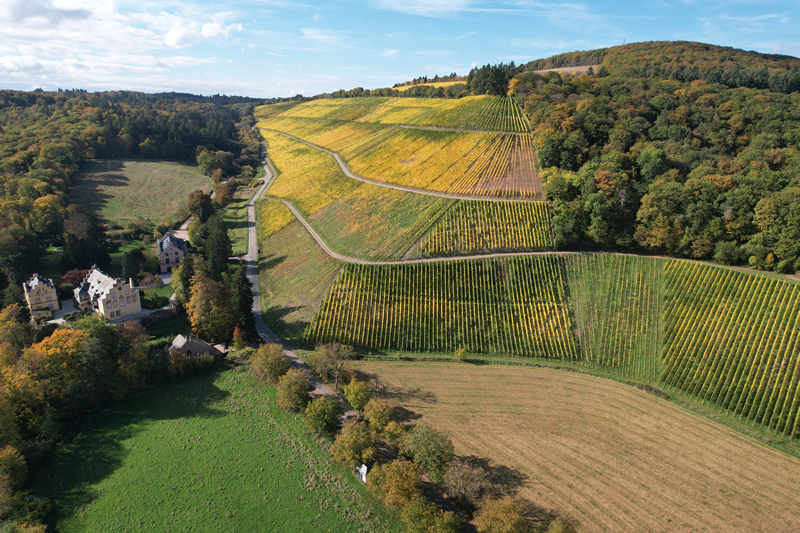
A zoomable artwork built from thousands of aerial images of the vineyard sites around Maximin Grünhaus on the Moselle – honoring the historic connection between Karl Marx, the Moselle and wine.
The mosaic of Karl Marx shown here is composed of thousands of aerial photographs of the vineyards of Maximin Grünhaus on the Moselle. It recalls a little-known connection between Marx and this place: in the 19th century, his family owned around one hectare of vines in the Herrenberg at Mertesdorf – precisely where the historic estate stands today.
Karl’s father, the Trier lawyer Heinrich Marx, acquired the southwest-facing parcels as an investment. After his father died in 1838, Karl Marx briefly became a vineyard owner before being paid out by his mother. For over thirty years, the vineyard remained in the family. When his mother passed away, Karl Marx sold the last five Fuder of wine stored in the cellar of their Trier home.
Wine played a larger role in Marx’s life than one might assume. Through his family’s ownership he encountered the Moselle wine crisis of the 1830s and 1840s – a social hardship that first led him to economic questions and the living conditions of vintners. In articles for the Rheinische Zeitung he criticized high taxation, administrative failure and the impoverishment of Moselle winegrowers. As Friedrich Engels later put it, these experiences moved him “from mere politics to economic relations” and shaped his thinking.
For Marx’s 200th birthday, Maximin Grünhaus honored this historical link with a special Riesling from the Herrenberg site: “Das Kapital” – a limited edition of 1,300 bottles, served at the celebration in Trier. A circle closed between philosophy, history and wine.